
Toyama Prefecture developed along the Sea of Japan through industries shaped heavily by geography, climate and seasonal work. The Tateyama mountain range supplied snowmelt rivers that fed fertile plains inland, while Toyama Bay supported fishing communities that relied on coastal trade, maritime labour and changing seasonal conditions throughout the year. Compared to larger Japanese cities, Toyama grew through smaller towns and working villages where farming, fishing and handcraft existed closely alongside one another for generations. Daily life depended heavily on practical material knowledge, particularly surrounding natural fibres, woven materials and rope construction used across both agricultural and maritime industries.
Straw twisting, fibre braiding and rope-making were originally functional skills connected to labour rather than decoration. These techniques were used for farming tools, fishing equipment, storage and seasonal work tied to everyday survival. Over centuries, however, the same practical knowledge contributed to the large ceremonial shimenawa ropes later associated with shrines and sacred spaces across Japan.

Toyama Bay has long shaped the region’s identity. Known for deep waters and dramatic coastal conditions, the bay supported generations of fishing communities dependent on seasonal migration cycles, weather patterns and physical maritime work. Rope construction and fibre handling became essential practical skills within these fishing villages. Nets, rigging and coastal equipment required durability and technical understanding of tension, weight and material behaviour. Knowledge was transferred directly through physical work rather than formal training systems, embedding craft into ordinary working life.
Further inland, rice cultivation developed extensively due to the region’s abundant water supply. Farming communities relied heavily on rice straw not only as an agricultural by-product, but as a reusable material integrated into everyday life. Straw was used for roofing, baskets, sandals, mats and rope production across rural Japan. Because farming and fishing communities existed so closely together, techniques surrounding fibre preparation and rope-making naturally overlapped between both industries. Material knowledge moved across trades through seasonal labour and collective work rather than remaining isolated within specialist crafts.

The making of shimenawa ropes emerged from this broader familiarity with straw-working and fibre construction. Large ceremonial ropes require substantial technical skill, particularly when working at architectural scale. Straw bundles must be dried, layered and twisted carefully while maintaining consistent density and structural balance throughout the entire process. Construction remains highly physical even today. Monumental ropes often involve multiple craftspeople working simultaneously, coordinating movement, rhythm and tension as the rope gradually increases in size. The process depends as much on teamwork and bodily coordination as individual craftsmanship.
In many ways, these methods reflected the collective labour systems already common within Toyama’s agricultural and fishing communities, where large seasonal tasks were regularly carried out through shared physical work. Unlike industrial manufacturing, handmade shimenawa also preserve evidence of human construction. Variations in fibre density, surface texture and twist patterns reveal the pace and movement of the making process itself. These irregularities are often what give handmade ropes their visual depth and tactile presence.

In Japan, shimenawa have long carried ceremonial associations linked to purification, boundaries and spiritual preparation within shrine culture. Yet the cultural meaning of the ropes extends beyond symbolism alone. The physical act of making them has historically been equally important. Large-scale rope construction required patience, repetition and close coordination between workers familiar with natural fibres and their behaviour under pressure. Skills were learned gradually through observation and participation over many years rather than through formalised education.
For this reason, shimenawa represent both material craft and collective labour. The finished object carries visible traces of process, effort and coordination, qualities increasingly valued within contemporary craft and hospitality environments seeking more tactile and materially expressive interiors.

Like many traditional Japanese craft industries, rope-making now exists within a changing social landscape. Rural depopulation and ageing communities have reduced the number of younger generations continuing labour-intensive regional practices. At the same time, architects, designers and cultural institutions have shown growing interest in rural Japanese craftsmanship over the past two decades. Attention has shifted toward forms of making connected to material honesty, slower production methods and visible evidence of handwork.
Regions such as Toyama have become increasingly important within these conversations because they preserve forms of knowledge shaped directly by landscape, labour and seasonal production rather than industrial manufacturing. Outside Japan, cities such as Tokyo, Osaka and Kyoto often dominate international perceptions of Japanese culture. Toyama presents a quieter and more rural version of the country, one grounded in agriculture, coastal work and collective forms of hand-making developed gradually over centuries.
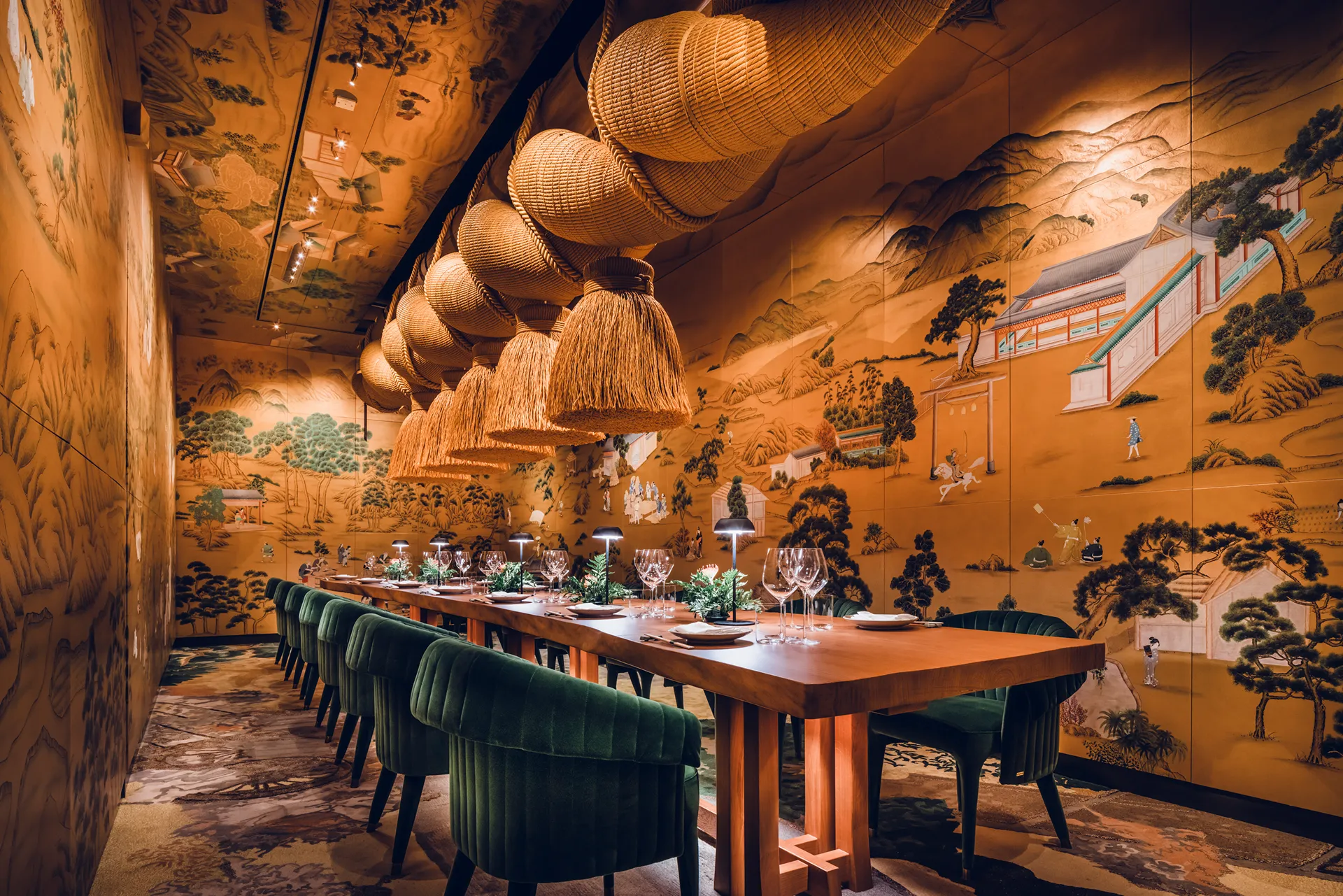
At Strawfire, references to shimenawa craftsmanship form part of the restaurant’s broader exploration of straw, fire and Japanese material culture. Large rope installations suspended within the private dining environment draw inspiration from traditions historically associated with regions such as Toyama, where rope-making developed through farming communities, fishing industries and collective physical labour tied closely to the surrounding landscape.
Within the restaurant, the ropes introduce texture, scale and visual weight while reinforcing the project’s wider material narrative. More importantly, the reference acknowledges the craft traditions and physical process behind shimenawa rather than reducing the ropes to decorative motifs alone. The growing presence of regional Japanese craft references within hospitality design reflects a wider interest in materials shaped by labour, process and cultural continuity. In contemporary dining environments especially, these forms of craftsmanship help create interiors that feel grounded, tactile and connected to histories extending beyond aesthetics alone.